

Defensive Line Techniques & Gap Identification
Foundational Football Knowledge

Topic
Defensive Line Techniques & Gap Identification
Situation
Foundational Football Knowledge
Essential for Coaches, Players, Parents, and Fans
Applies to Every Front, Coverage, and Run Fit in Football
Why I’m Teaching It
Before you can understand defensive fronts, blitzes, run fits, or coverage rotations, you must understand defensive line techniques and gap responsibility.
Everything starts with alignment. A defensive coordinator cannot assign gap control until players understand where they are aligned relative to the offensive line. Once you understand techniques, understanding fronts becomes significantly easier.
Simple language. Clear rules. Better football understanding.
Defensive Line Technique Structure
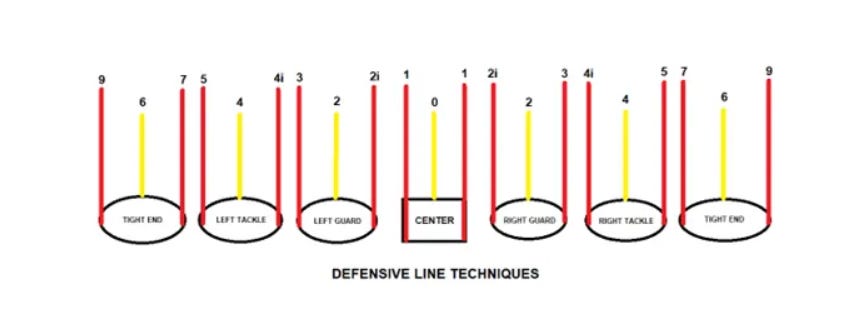
Defensive line techniques are numbered alignments that tell defenders where they line up relative to an offensive lineman or tight end.
The numbering system helps coaches communicate fronts quickly and efficiently.
Even Techniques
Even-numbered techniques are aligned head-up on an offensive player.
0 Technique
Head-up on the center
Commonly called a Nose Guard or Nose Tackle
Coaching Point
Controls both A-gaps
Often used in odd fronts
2 Technique
Head-up on the guard
Coaching Point
Must control both A-gap and B-gap movement
4 Technique
Head-up on the tackle
Coaching Point
Frequently used in 3-man defensive fronts
6 Technique
Head-up on the tight end
Coaching Point
Commonly used versus tight end formations
Helps establish edge control
Outside Shade Techniques
Odd-numbered techniques align on the outside shoulder of an offensive player.
1 Technique
Outside shade of the center
Coaching Point
Primarily responsible for an A-gap
3 Technique
Outside shade of the guard
Coaching Point
One of the most disruptive positions in football
Frequently attacks the B-gap
5 Technique
Outside shade of the tackle
Coaching Point
Primary edge defender in many fronts
9 Technique
Outside shade of the tight end
Coaching Point
Creates width
Helps set the edge
Common versus outside run teams
Inside Shade Techniques
Inside-shade alignments place the defender on the inside shoulder of an offensive player.
2i Technique
Inside shade of the guard
Coaching Point
Attacks the A-gap
4i Technique
Inside shade of the tackle
Coaching Point
Creates difficult blocking angles
Frequently used in modern defensive structures
7 Technique
Inside shade of the tight end
Coaching Point
The exception to the numbering pattern
Although many assume it would be a “6i,” football terminology identifies this alignment as a 7 technique
Gap Identification
Understanding techniques is only half the equation. Defenders are aligned to control specific gaps.
A Gap
Between the center and guard
There are two A-gaps:
Right A-gap
Left A-gap
B Gap
Between the guard and tackle
There are two B-gaps:
Right B-gap
Left B-gap
C Gap
Between the tackle and tight end
There are two C-gaps:
Right C-gap
Left C-gap
D Gap
Outside the tight end
Everything outside the tight end becomes the D-gap extending toward the sideline.
Why Techniques Matter
Technique alignment determines:
Gap responsibility
Run fits
Blitz paths
Stunt angles
Pass rush lanes
Front structure
A defensive coordinator cannot effectively teach a front without first teaching techniques.
Coaching Points
Learn techniques before learning fronts
Understand alignment before assignment
Techniques determine gap control
Gap control determines run fits
Run fits determine defensive success
Football becomes much easier once players understand where they line up and what gap they own.
What Everybody’s Doing (Defensive Stress)
Defensive linemen control assigned gaps
Linebackers fit off defensive line movement
Safeties fit off linebacker leverage
Entire front works together to eliminate running lanes
Great defenses are built on gap integrity.
One player out of a gap can create an explosive play.
Summary
Defensive line techniques are the language of defensive football. The numbering system tells defenders exactly where to align, while gaps tell them where they are responsible.
Mastering techniques and gap identification creates the foundation for understanding fronts, blitzes, run fits, and coverage structure.
Alignment first. Assignment second. Play fast.
What’s Next
In future breakdowns, we’ll take these techniques and apply them to real defensive fronts, including Even, Odd, Bear, Over, Under, Tite, Mint, and Eagle structures. We’ll also break down gap control, spill and box principles, run fits, linebacker responsibilities, and how defensive coordinators use technique alignments to create advantages against specific offensive schemes. The full defensive front library will be available in the coming weeks.